
Overview
Use Apollo API to work with Apollo data and create programmatic workflows with the tools and systems your team already uses. You can find and enrich people and companies, create and manage records, add contacts to sequences, and build repeatable GTM workflows without completing each task manually in Apollo.
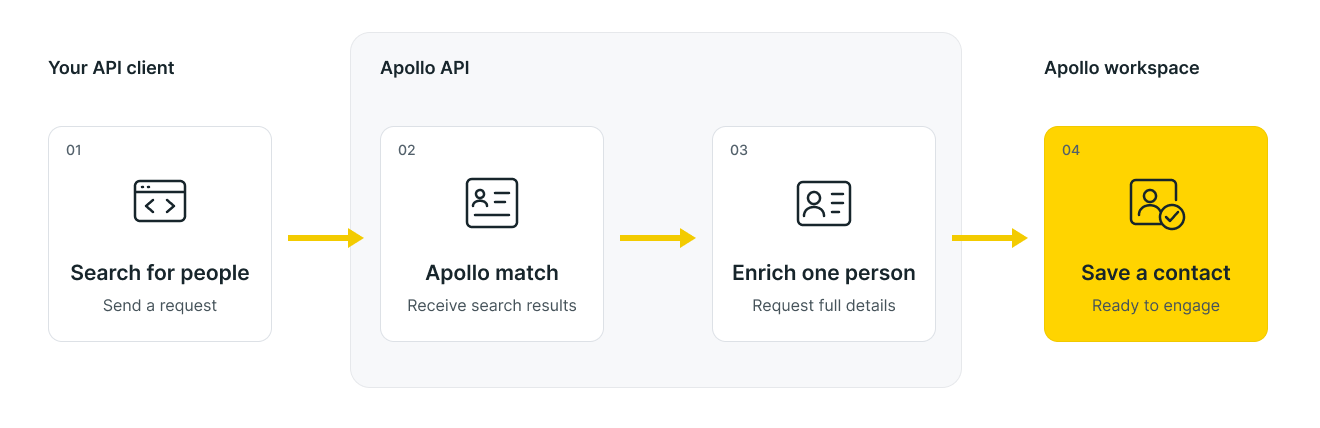
Apollo API is available on all Apollo plans, but access to specific endpoints, rate limits, and credit usage vary. If you're on a free plan, you need a work email address to use people and company search and enrichment endpoints.
Apollo API works with API keys or OAuth.
- API keys: For most users, API keys are sufficient for custom workflows. Each key authenticates requests and can be limited to specific endpoints to protect workspace data.
- OAuth: If you're a partner building an integration for other Apollo users, use OAuth 2.0 so those users can authorize your integration to access their Apollo accounts.
This guide focuses on API key authentication with a prospect and enrichment workflow.
As you work through the guide, use these definitions to understand common Apollo terms:
Account: A company you've saved in Apollo.
Company: A company in Apollo's database that isn't saved to your workspace.
Contact: A person you've saved in Apollo.
Endpoint: An Apollo API URL that performs a specific action, such as searching for people or enriching a record.
Enrichment: The process of adding or updating information about a person or company using Apollo data.
Person: A person in Apollo's database who isn't saved to your workspace.
Workspace: Your team's Apollo instance, where you manage records, users, and settings.
Check out the following sections to get started with Apollo API.
Set Up Your Dev Space
First, create an API key and test your connection. You can work directly in Apollo Developer Docs or use your preferred development tools.
To create an API key, you need permission to edit integration settings in Apollo. If you don't have permission, reach out to an Apollo admin for help.
To create an API key:
- Open Apollo and click Settings > Integrations > API Keys.
- Click Create new key, then enter a name and description for your key.
- Select each API endpoint that you want the key to have access to. Alternatively, toggle Set as master key to select all endpoints. Apollo recommends you use a scoped key limited to the endpoints your integration calls. Create a master key only when an endpoint requires one.
- Select the integration type:
- Private: Custom built for and used by one Apollo customer.
- Public: Publicly available for any Apollo customer to connect and use.
- Reseller: Provides access to Apollo data without requiring the end user to connect their own Apollo account.
- Click Create API key.
- Click Copy and store your key securely. Anyone with access to your key may be able to take action in your Apollo workspace.
You have now created an API key.
Next, test your key.
You can test directly on Apollo Developer Docs or use this flow in an API client such as Postman:
- In your API client, create a new request.
- Set the request method to GET, then enter the following URL:
https://api.apollo.io/api/v1/auth/health- Set the authorization type to No Auth.
- Add the following headers.
Content-Type: application/json
Cache-Control: no-cache
x-api-key: YOUR_API_KEY
Replace YOUR_API_KEY with the API key you copied from Apollo.
- Send the request. If your key works, Apollo returns the following response:
{
  "healthy": true,
  "is_logged_in": true
}
If either value is false, check your headers and authorization. Make sure you copied the API key correctly and that it doesn't contain extra spaces or line breaks. Then send the request again.
You have now tested your connection to Apollo API. You're ready to explore endpoints and build your first workflow.
You've now tested your setup, and you're ready to use Apollo API to find new prospects.
Find People
Start by using Apollo API to find people who match your target criteria. In this example, search for sales directors in California, Oregon, or Washington, then use a result in the next section to retrieve more information about that person.
To find people:
- In your API client, create a new request.
- Set the request method to POST, then enter the following URL:
https://api.apollo.io/api/v1/mixed_people/api_search- Set the authorization type to No Auth, then add the following headers:
Content-Type: application/json
Cache-Control: no-cache
x-api-key: YOUR_API_KEY
Replace YOUR_API_KEY with your Apollo API key. Make sure the key has access to the people API search endpoint.
- Add the following parameters to your request body as JSON:
{
  "person_titles": ["sales director", "director sales", "director, sales"],
  "person_locations": ["California, US", "Oregon, US", "Washington, US"],
  "per_page": 5
}
These parameters tell Apollo which people to find and limit the response to five results per page. You can change the titles and locations to match your own target audience.
- Send the request. A successful request returns a
200status and a list of matching people. Each result includes an Apollo person ID, along with limited information about the person and their company.
You've now retrieved a list of people who match your criteria.
Next, enrich a person to retrieve additional details. Copy the id value for a person you want to learn more about. Use it in the next section to retrieve available information about that person, including their email address.
Want to search by different criteria? Explore the people search endpoint for all the available parameters. For a deeper prospecting tutorial, check out Find People with Filters on the Developer Docs.
To search for companies instead, use the company search endpoint.
Enrich a Person
People search doesn't return email addresses or phone numbers. To retrieve additional information, enrich the people you choose with the enrichment endpoint. People search doesn't consume credits, but enrichment can consume credits based on the data returned.
In this example, use the Apollo person ID from your search results to enrich one person. Apollo can return details such as their job title, company information, and email address when available.
To enrich a person:
- In your API client, create a new request.
- Set the request method to POST, then enter the following URL:
https://api.apollo.io/api/v1/people/match- Set the authorization type to No Auth, then add the following headers:
Content-Type: application/json
Cache-Control: no-cache
x-api-key: YOUR_API_KEY
Replace YOUR_API_KEY with your Apollo API key. Make sure the key has access to the people enrichment endpoint.
- Add the following parameter to your request body as JSON:
{
  "id": "PERSON_ID"
}
Replace PERSON_ID with the id value you copied from your people search results.
- Send the request. A successful request returns a
200status and the available information Apollo found for the person.
You've now enriched a person from your search results. Next, use the returned information to save the person as a contact in your Apollo workspace. This keeps their information available to your team so you can retrieve it later or use it for outreach in Apollo.
You don't need to search Apollo first if you already have information about a person. For example, if someone fills out a form on your website, you can send their email address to the people enrichment endpoint. Apollo uses it to find the person in its database and returns additional information when available. You can also send up to ten people in one request with the bulk people enrichment endpoint. Learn more in enriching people with Apollo API.
Save a Contact
Save the enriched person as a contact so your team can access their information in Apollo and use it for workflows such as outreach. Once saved, you can retrieve the contact without enriching the same person again.
To save a contact:
- In your API client, create a new request.
- Set the request method to POST, then enter the following URL:
https://api.apollo.io/api/v1/contacts- Set the authorization type to No Auth, then add the following headers:
Content-Type: application/json
Cache-Control: no-cache
x-api-key: YOUR_API_KEY
Replace YOUR_API_KEY with your Apollo API key. Make sure the key has access to the create a contact endpoint.
- Add the following parameters to your request body as JSON:
{
  "first_name": "FIRST_NAME",
  "last_name": "LAST_NAME",
  "organization_name": "COMPANY_NAME",
  "email": "EMAIL_ADDRESS"
}
Replace the placeholder values with the corresponding details from your enrichment response. Include only information Apollo returned or that you otherwise have available.
- Send the request. A successful request returns a
200status and the saved contact's details, including a contactid.
You've now found a person, enriched their information, and saved them as a contact in Apollo. You can use the contact ID to retrieve the contact later or work with the contact in another Apollo API workflow.
By default, Apollo creates a new contact even if a matching contact already exists. You can enable deduplication, but this may update an existing contact with the values you send. Review the create a contact endpoint before using it.
FAQs
|
Frequently asked questions |
||
| Why does my API request return a 403 error? | What happens when I reach a rate limit? | How can I monitor API and credit usage? |
| Why didn't Apollo return a phone number? | Can an enrichment request use credits if no data is found? | Can I use the same API key for multiple integrations? |
Why does my API request return a 403 error?
A 403 error means Apollo couldn't authorize the request. Check that your API key includes access to the endpoint you're calling and that the endpoint is available with your Apollo plan. Some endpoints require a master key.
For more help, check out status codes and errors on Apollo Developer Docs.
What happens when I reach a rate limit?
When you exceed a rate limit, Apollo returns a 429 error. Check the rate-limit response headers to see your remaining allowance and when the limit resets, then retry your request after the reset.
Rate limits and credits are separate: you can reach a rate limit even when you have credits available. Learn more about rate limits.
How can I monitor API and credit usage?
Use the API usage stats endpoint to review your team's API usage and endpoint rate limits.
Use the credit usage stats endpoint to check your team's credit allowances, usage, and remaining balances for the current billing cycle.
Why didn't Apollo return a phone number?
By default, people enrichment doesn't return phone numbers. To request available phone numbers, set reveal_phone_number to true. Phone enrichment runs asynchronously, so the results arrive separately from the initial response.
You can receive results at a webhook URL or retrieve them by polling. A phone number isn't guaranteed for every person. Learn how to retrieve phone numbers and review the people enrichment endpoint for retrieval options.
Can an enrichment request use credits if no data is found?
For people enrichment, Apollo doesn't charge credits when no credit-consuming data is found. If you use waterfall enrichment with your request, some connected providers consume credits for a lookup even when they don't return data.
Credit usage depends on the endpoint, your plan, the data returned, and your waterfall enrichment configuration. Check out API pricing and credits to understand credit consumption before running a workflow at scale.
Can I use the same API key for multiple integrations?
Yes, you can—but consider creating a separate key for each integration. Separate keys can limit disruptions, improve activity tracking, and prevent failures when keys are regenerated or deleted. Instead, use 1:1 key-to-integrations, and limit each key only to the endpoints each integration needs.
Learn how to create and manage API keys.
Next Steps
Now that you understand the basics, keep building with Apollo API.
Apollo's Developer Docs provide tutorials and references. You can also test requests directly on the docs, use AI to search and ask questions, or share your screen with an AI assistant for help. If you work with a development tool, use the OpenAPI specification to generate an SDK or import endpoints into your tool.
| Add Contacts to a Sequence | Ready to start outreach? Add saved contacts to an existing sequence with Apollo API. |
|---|---|
| Retrieve Mobile Phone Numbers | Want to reach prospects by phone? Learn how to retrieve available mobile and direct-dial numbers for a person. |
| Bulk People Enrichment | Working with multiple people? Enrich up to ten people in a single request. |
| Company Enrichment | Enrich a company using its domain, website, or name to retrieve details such as industry, employee count, and revenue. |
| Apollo API Tutorials | Looking for more examples? Explore Apollo API tutorials to build additional workflows with Apollo data. |
| Apollo API Reference | Browse all Apollo API endpoints to manage records, engage prospects, and work with your Apollo workspace. |