
Overview
Once you connect Salesforce to Apollo, you can configure how Apollo pulls data from Salesforce into Apollo. Pull settings let you customize which Salesforce data Apollo imports.
After you enable the Salesforce integration on a paid Apollo plan, there's a six-hour window to configure push settings and pull settings and map fields. This gives you time to properly configure the integration. During this time, you can't manually pull records. After six hours, Apollo automatically enables syncing.
Missed the window? You can still adjust sync settings at any time. Go to Settings > Integrations > All integrations, then open Salesforce to review or update pull settings. Records already imported aren't automatically re-pulled if you tighten conditions or add a new field or stage mapping. Click Pull all on the relevant record type to apply any updated settings and mappings to existing Apollo records.
Check out the following sections to configure what Apollo pulls from Salesforce.
Configure Pull Settings
To configure Salesforce integration pull settings:
- Launch Apollo and click Settings > Integrations > All integrations, then open Salesforce.
- Click Contacts, Leads, Accounts, Deals, or Activities, then click Sync.
Apollo automatically pulls all contacts and leads from Salesforce to Apollo as contacts, then makes them visible to your team when prospecting in Apollo. However, you can use selective sync to set conditions that define how you sync contacts from Salesforce. Selective sync may be useful to avoid pulling unneeded records.
You can also configure record visibility, which determines whether Salesforce contacts are visible to your team when prospecting in Apollo.
You can manually pull all contacts. This may be useful after making a change to a field or stage mapping.
Selective sync
Selective sync is available on certain Apollo plans purchased after July 24, 2024. To access selective sync, upgrade your plan. If you have questions about upgrading, reach out to the sales team.
- To use selective sync, toggle Pull contacts based on specific conditions, then click Add pull conditions.
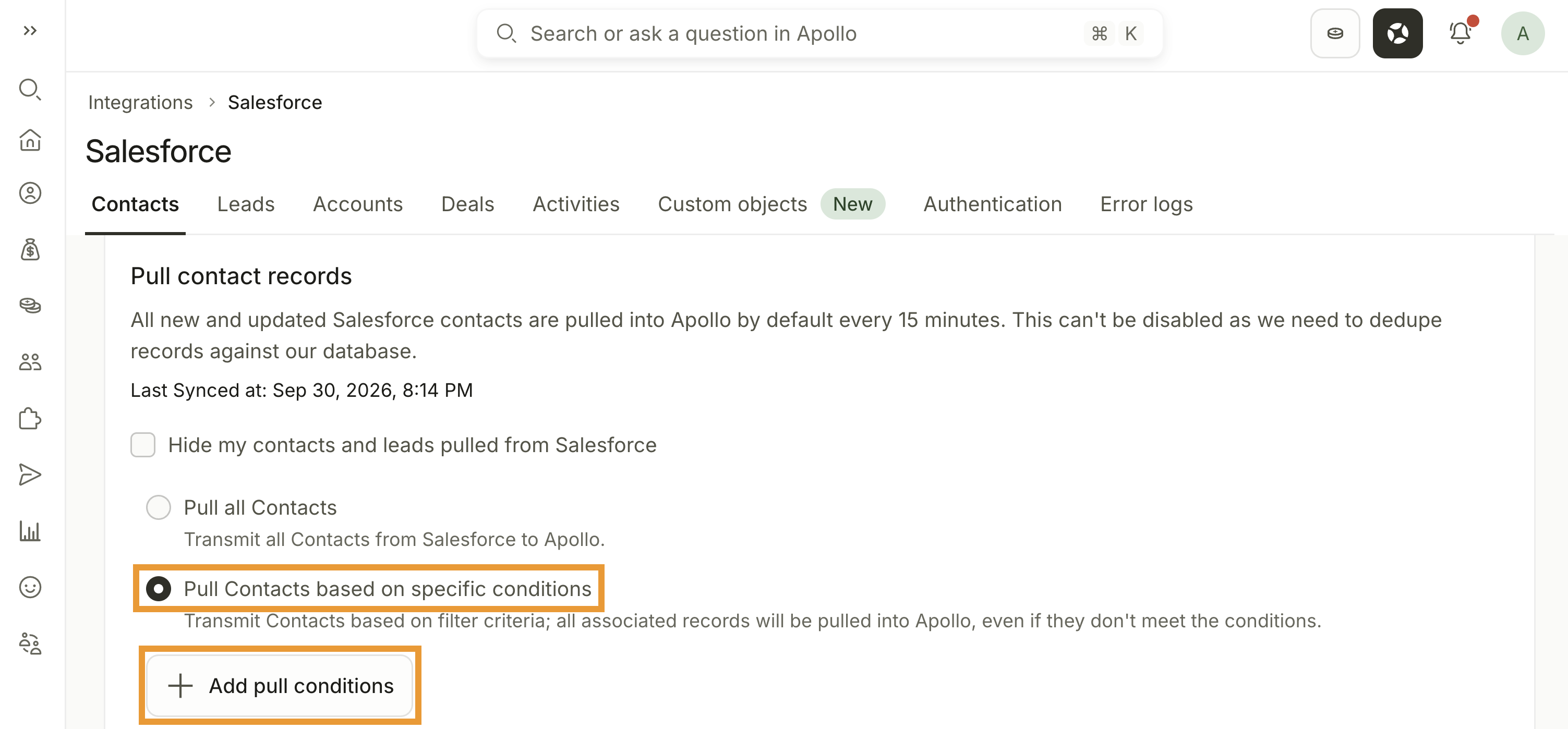
- Click + AND condition to add conditions like owner, status, created date, and more. Each condition works with
ANDlogic, meaning if you add a condition where owner includesMaria Yuaraand created date is01/01/2025 — 12/31/2025, then Apollo only syncs contacts owned by Maria that were created in 2025. - Add and edit more conditions as needed. You can add up to twenty conditions.
- When finished, click Save.
You have now configured selective sync. Apollo only pulls contacts matching the conditions you set.
Manual pull
Manual pull allows you to pull all records from Salesforce at once. After you add or change a field or stage mapping, click Pull all to apply Salesforce data to existing Apollo records.
To manually pull records:
- Click Pull all contacts.
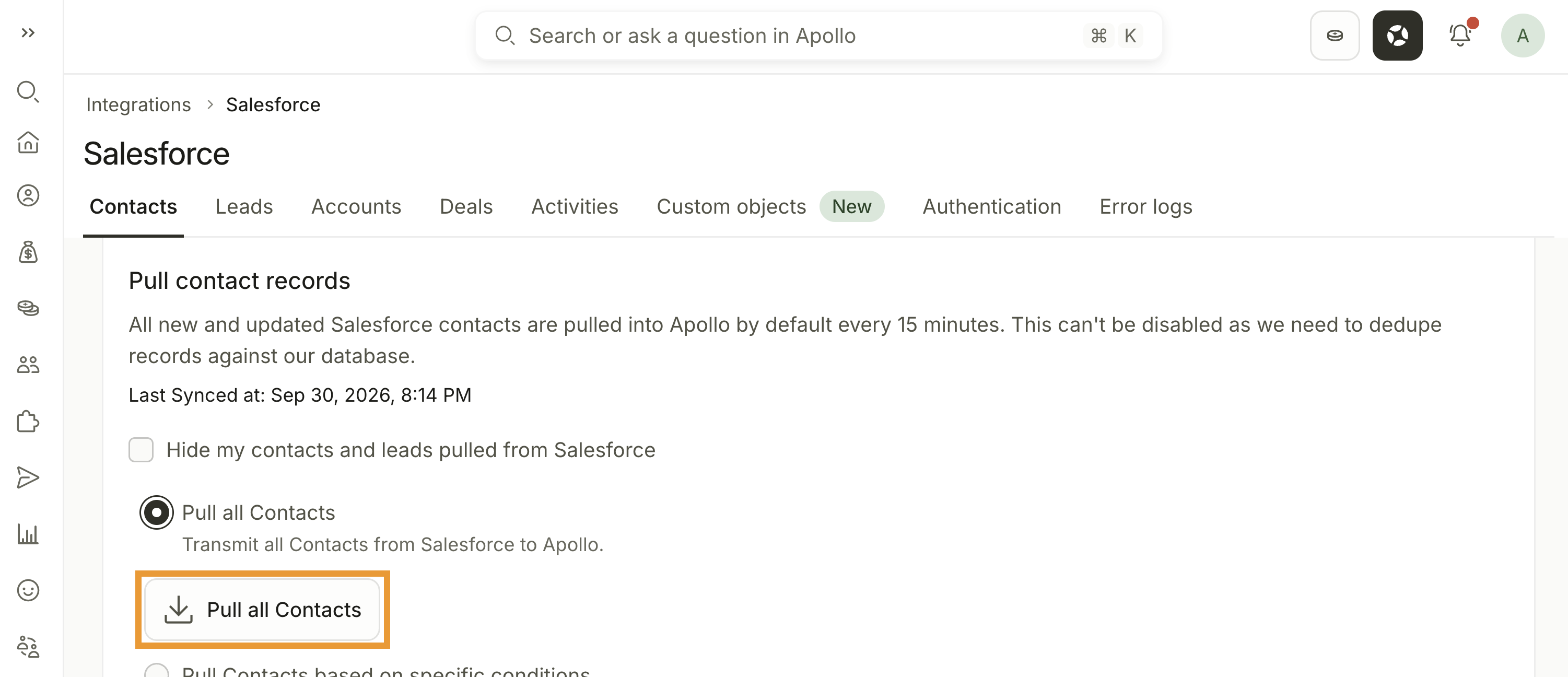
Manual pull all doesn't work with selective sync. After connecting the integration for the first time or triggering a manual pull, the sync process may take several hours to complete, depending on the number of records in your CRM. After that, Apollo automatically syncs any new or updated records from Salesforce every 30 minutes.
You have now manually pulled your contacts.
Record visibility
By default, Apollo makes contacts synced from Salesforce visible to your team when prospecting in Apollo. This is the recommended setting to engage with contacts.
To change record visibility:
- Check Hide my contacts and leads pulled from Salesforce, then click Save.
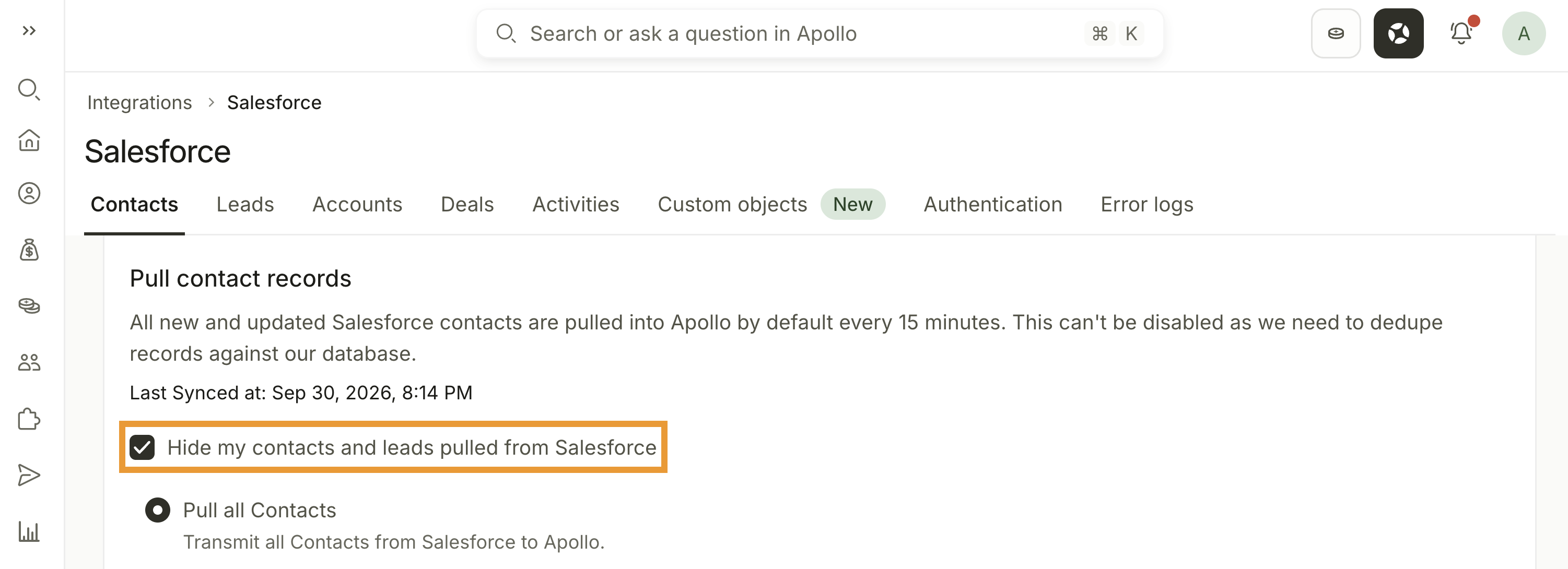
You have now changed record visibility.
Apollo automatically pulls all accounts from Salesforce and makes them visible to your team when prospecting in Apollo. You can change the visibility of pulled accounts if you don't want your team to see them in Apollo.
You can use selective sync to set conditions for the Salesforce accounts Apollo pulls. This can help prevent Apollo from importing accounts your team does not need.
If an account pulled from Salesforce doesn't include a name or website, Apollo can infer missing information and enrich the account with updated data.
You can also manually pull all accounts from Salesforce. This may be useful after you change a field or stage mapping, so you can apply the updated mapping to existing Apollo accounts.
Selective sync
Selective sync is available on certain Apollo plans. To access selective sync, upgrade your plan. If you have questions about upgrading, reach out to the sales team.
Use selective sync to set conditions that define how you sync accounts from Salesforce. Selective sync may be useful to avoid pulling unneeded records.
- To use selective sync, toggle Pull accounts based on specific conditions, then click Add pull conditions.
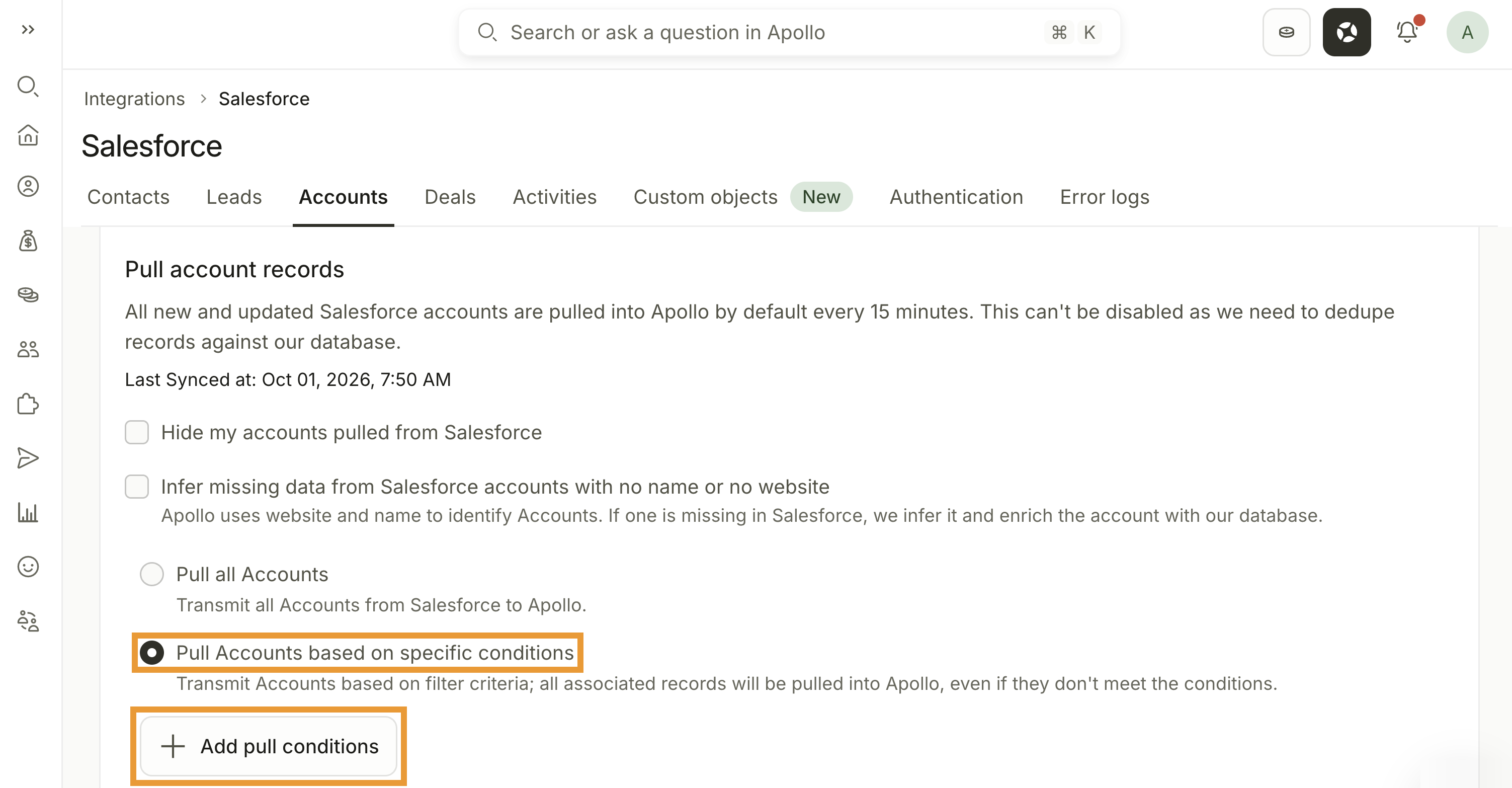
- Click + AND condition to add conditions like owner, status, created date, and more. Each condition works with
ANDlogic, meaning if you add a condition where owner includesMaria Yuaraand created date is01/01/2025 — 12/31/2025, then Apollo only syncs accounts owned by Maria that were created in 2025. - Add and edit more conditions as needed. You can add up to twenty conditions.
- When finished, click Save.
You have now configured selective sync. Apollo only pulls accounts matching the conditions you set.
Infer missing data
If accounts pulled from Salesforce have no name or website, Apollo can infer and enrich those records with updated information from Apollo's database.
To configure inferring account data:
- Check Infer missing data from Salesforce accounts with no name or website, then click Save.
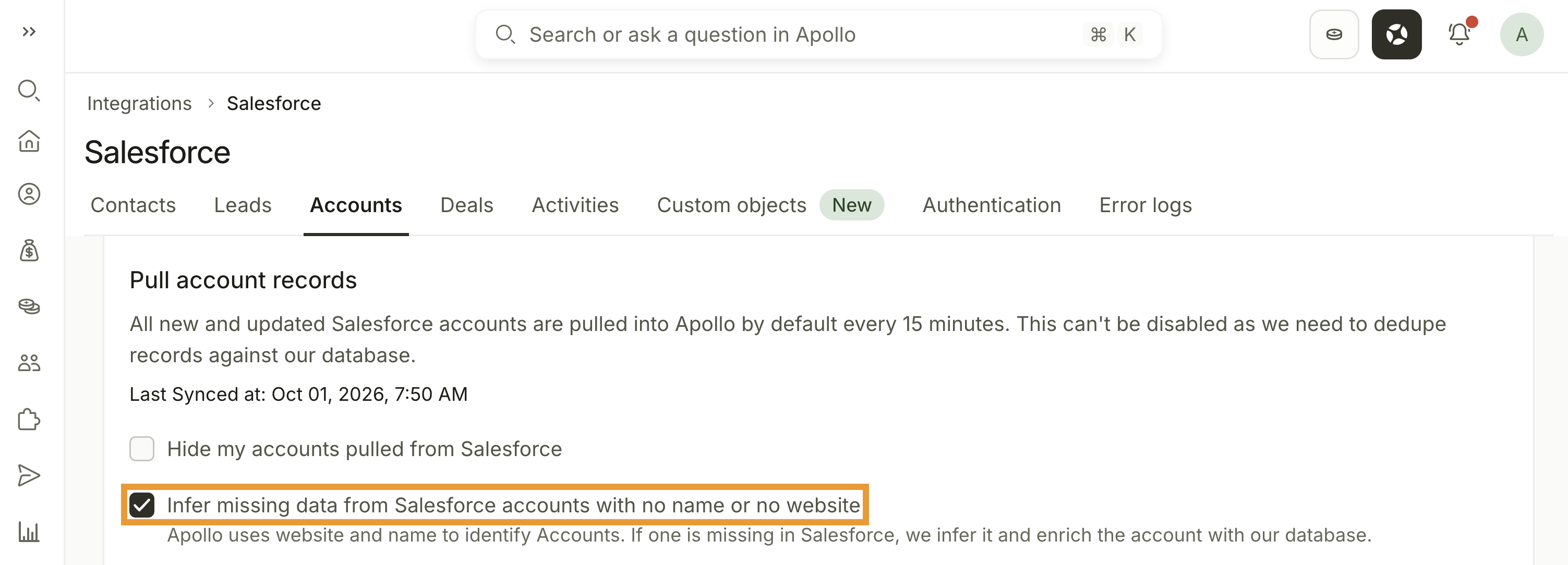
Apollo infers missing name and website data for accounts pulled from Salesforce.
Accounts are best enriched when Apollo can infer data for both name and website fields. If Apollo finds data for only one of these fields, the account is still enriched, but data accuracy may vary.
Manual pull
Manual pull allows you to pull all records from Salesforce at once. After you add or change a field or stage mapping, use a manual pull all to apply the updated configuration to existing Apollo records.
To manually pull records:
- Click Pull all accounts.
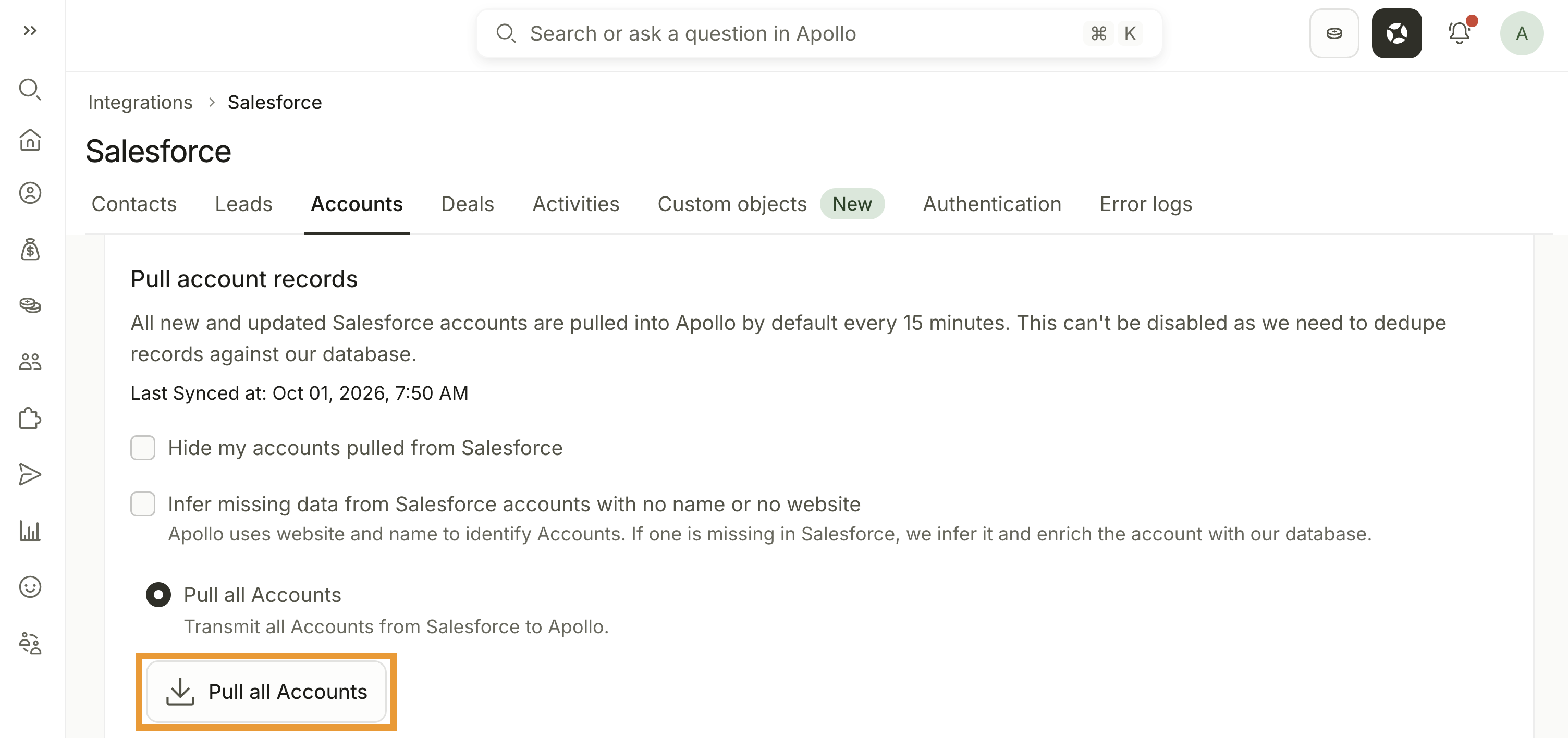
Manual pull all doesn't work with selective sync enabled. Once initiated, it may take up to 30 minutes for Apollo to pull your records from Salesforce.
You have now manually pulled accounts.
Record visibility
By default, Apollo makes accounts synced from Salesforce visible to your team when prospecting in Apollo. This is the recommended setting to engage with accounts.
To change record visibility:
- Check Hide my accounts pulled from Salesforce, then click Save.
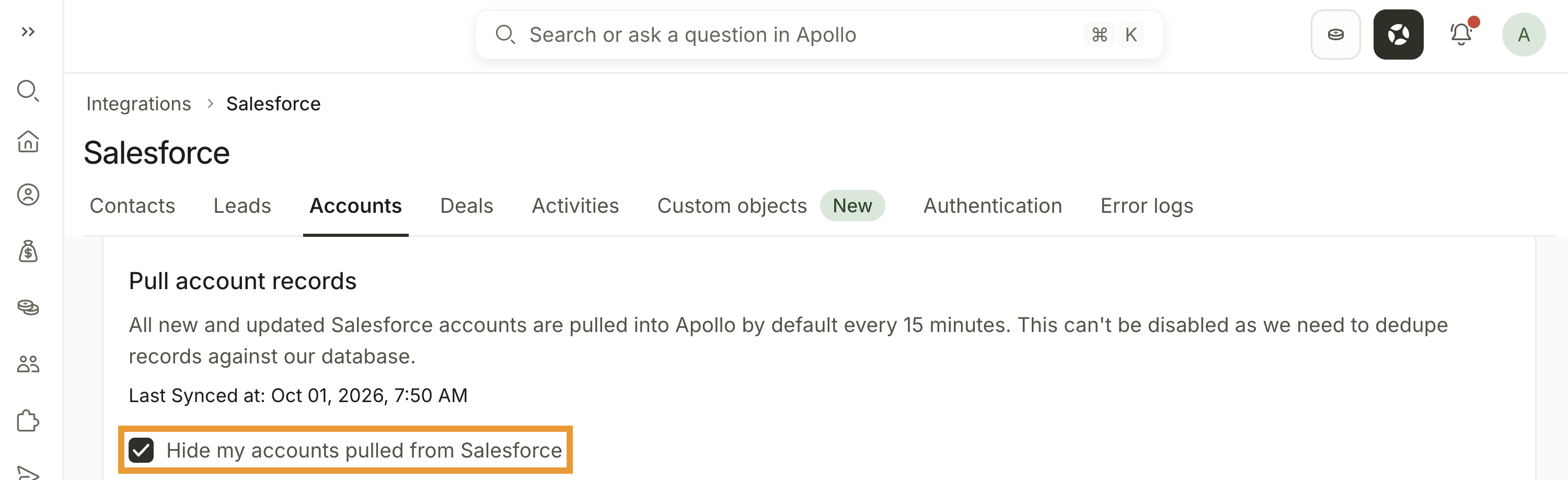
You have now changed record visibility.
To configure pull settings for deals:
- Check Sync deals with Apollo to actively sync pipeline and deal information bidirectionally when Apollo detects a change.
- Ensure that Pull opportunities is checked.
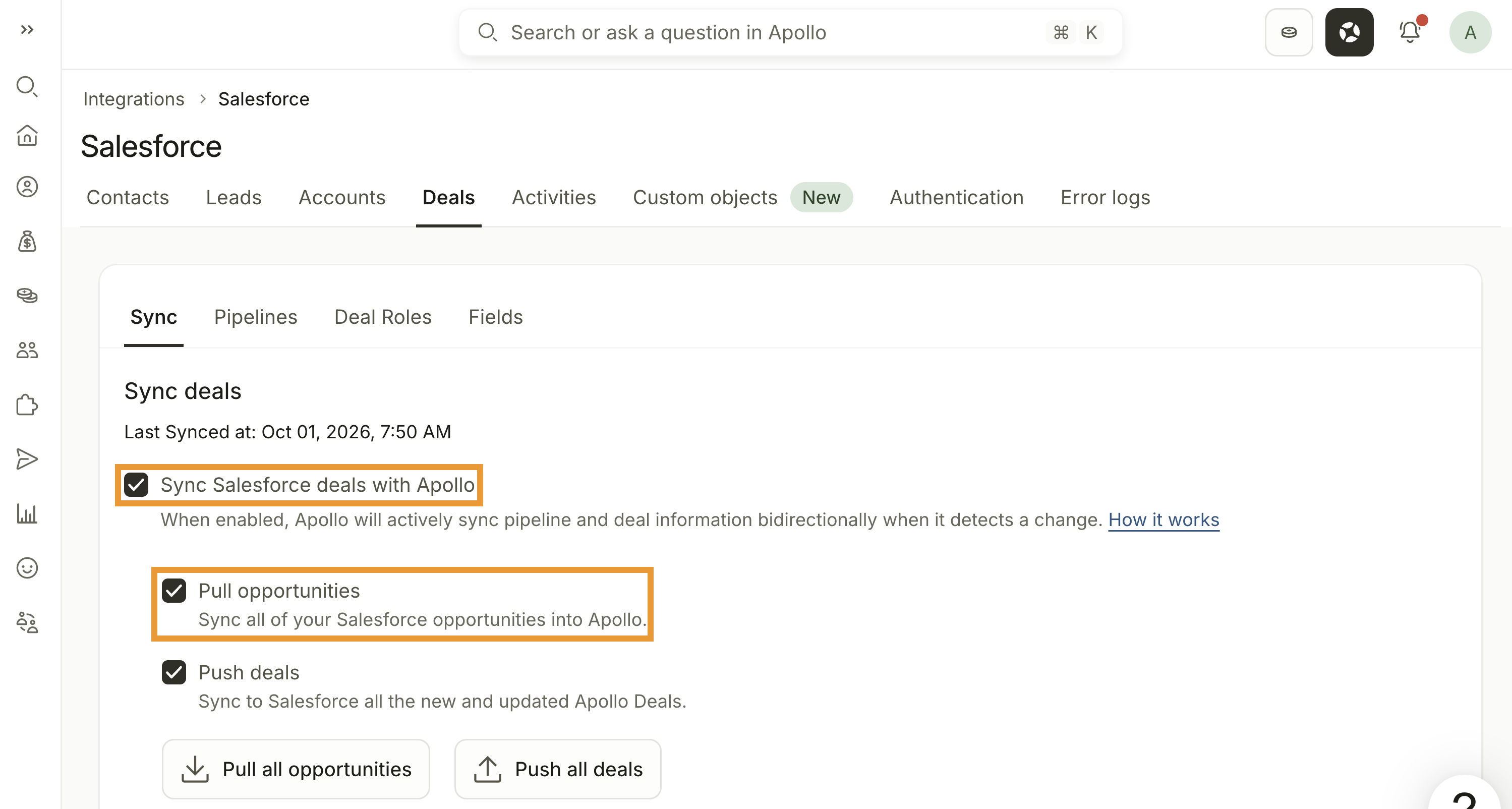
- When enabled, Apollo pulls all Salesforce opportunity (deal) information and uses Salesforce as the source of truth for any previously synced deals.
- If you deactivate this setting at any point, Salesforce deal information remains in Apollo, but Apollo no longer actively syncs with Salesforce.
- (Optional) Click to manually pull all opportunities. This may be useful if you recently changed your sync settings.
Once initiated, it may take up to 30 minutes for Apollo to pull your records from Salesforce.
- (Optional) Check Hide my deals to hide deals pulled from Salesforce to Apollo. When enabled, synced deals won't appear in Apollo, but automations could still update deals in Salesforce.
- When finished, click Save.
You have now configured pull settings for deals.
You can pull activities like tasks from Salesforce to Apollo.
To configure pull settings for activities:
- Check Pull tasks to pull Salesforce tasks to Apollo.
- When finished, click Save.
You have now enabled task pull, and Apollo automatically syncs tasks from Salesforce. Apollo pulls both completed and scheduled / open tasks from Salesforce into Apollo. This allows your team to view and manage task activity across both systems.
Once initiated, it may take up to 30 minutes for Apollo to pull your records from Salesforce.
- When finished, click Save.
You have now configured pull settings for activities.
View Pull History
By default, all new or updated contacts and accounts are pulled from Salesforce to Apollo every fifteen minutes. With pull history, Apollo shows queued record pulls as well as your historical pull log so you can see exactly when records came from Salesforce.
To use pull history:
- Launch Apollo and click Settings > Integrations > All integrations, then open Salesforce.
- Click Contacts, Leads, or Accounts, then click Sync.
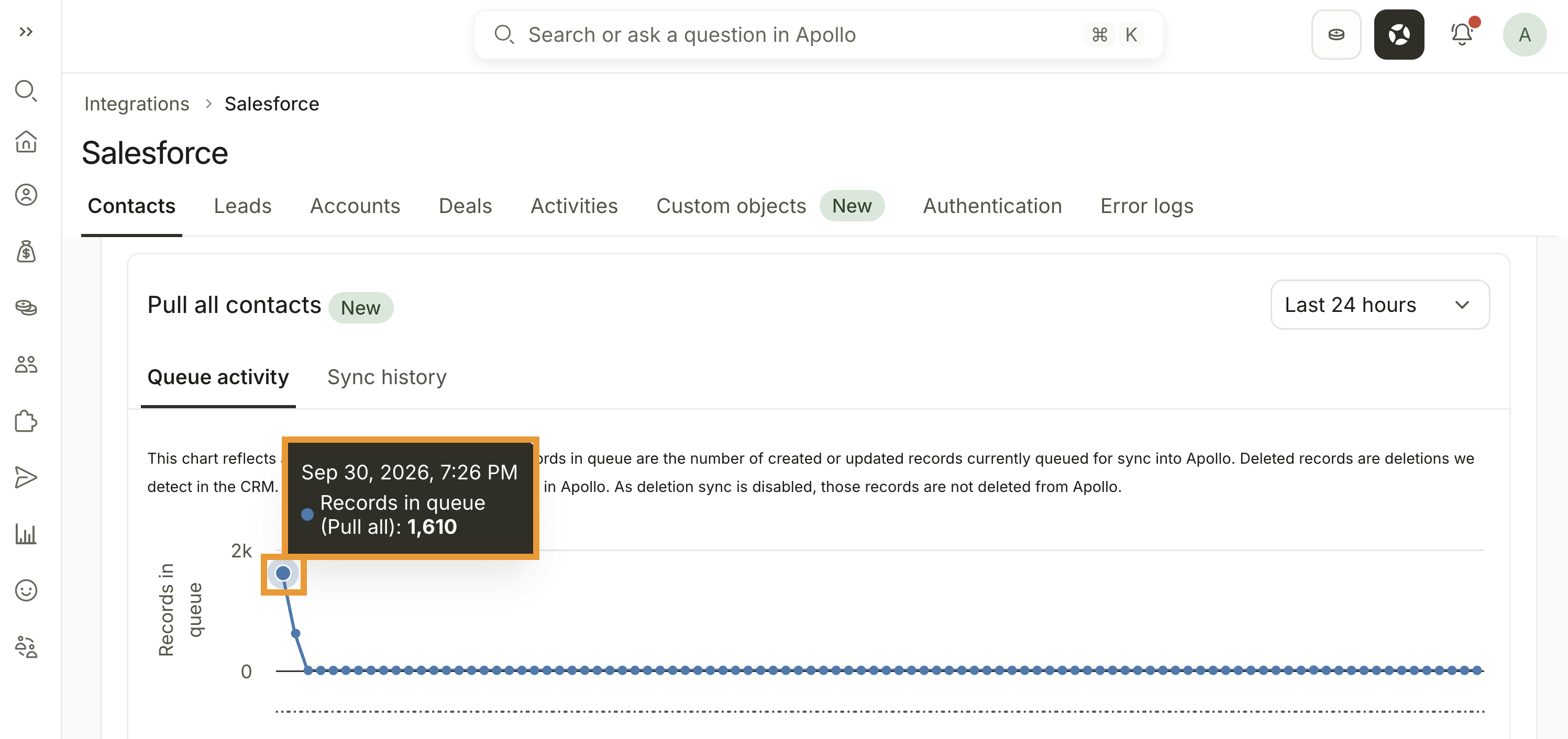
- Scroll to Pull all, then click Queue activity to review queued records, or Sync history for an activity log.
- Apollo displays queued record pulls along a timeline, including when each pull request occurred and how many records are queued, so you can easily visualize your activity. This may be helpful to spot progress on very large data pulls from Salesforce.
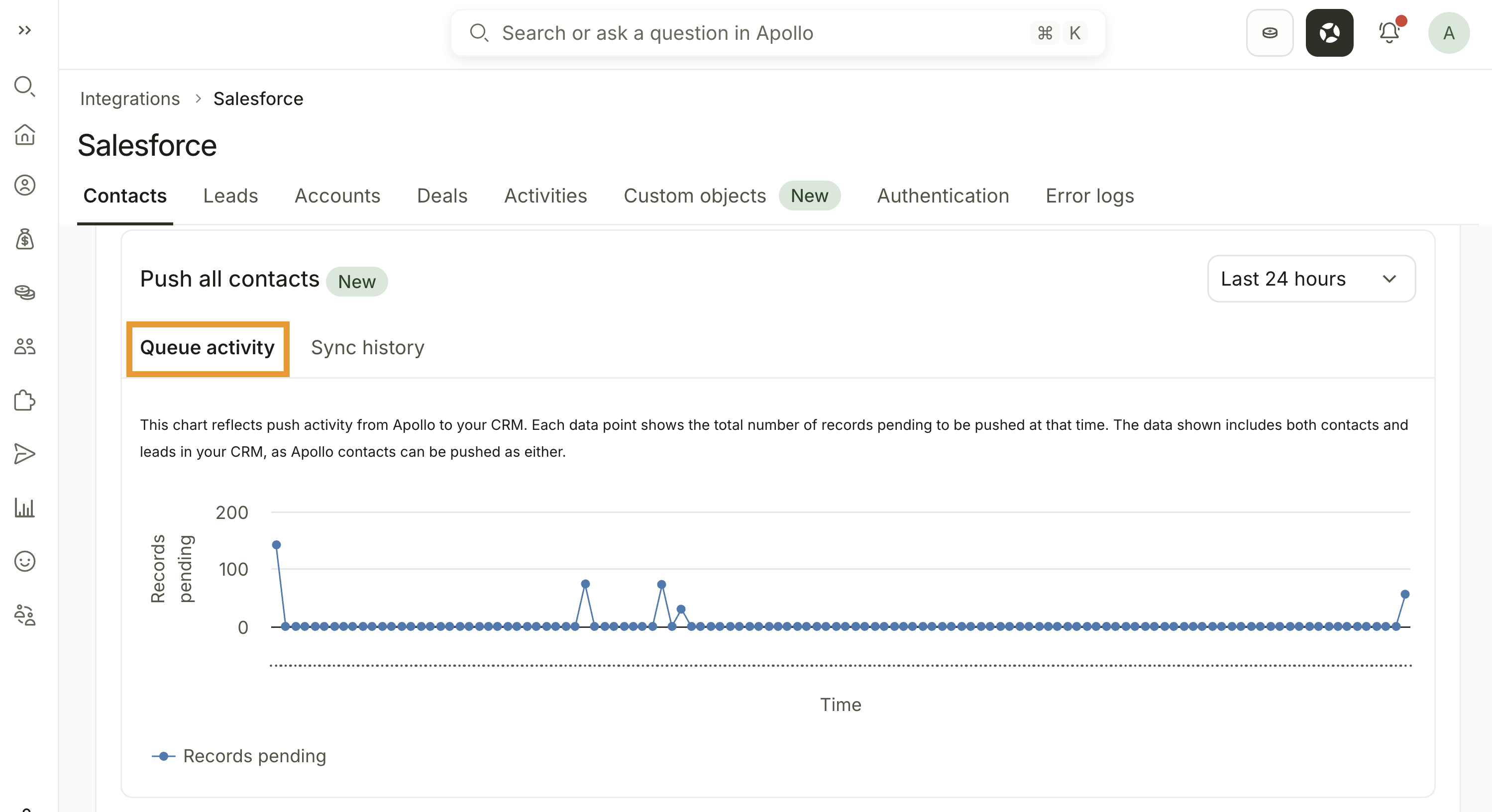
- (Optional) Click Last 24 hours to change the time, then select Last 3 days, Last 7 days, or Custom for a date range.
- Hover over a queued pull to see the exact date and time of the pull request, as well as the number of records queued.
- Apollo displays a log of completed pulls from Salesforce to Apollo. Each entry shows when the sync ran and whether any records were updated.
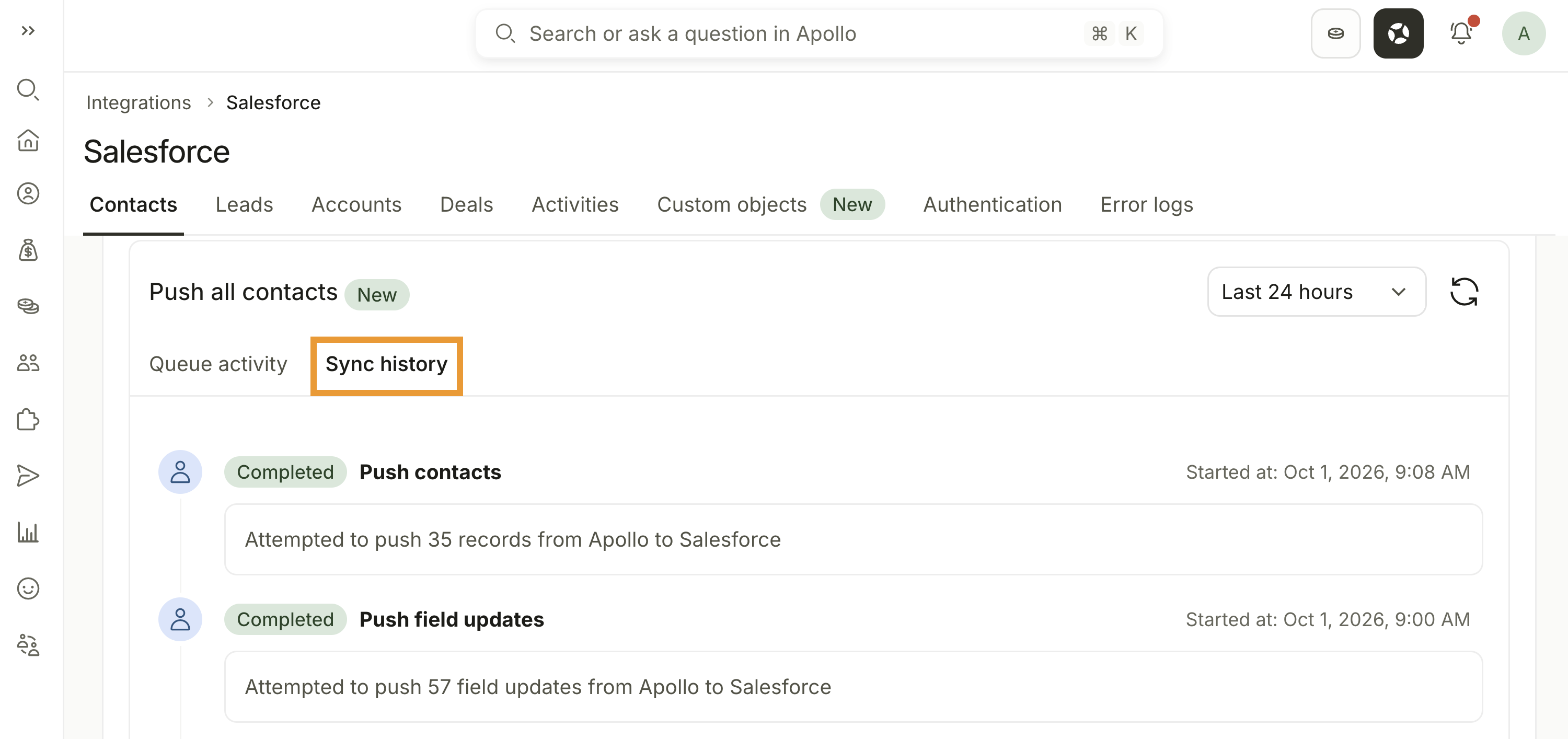
- (Optional) Click Last 24 hours to change the time, then select Last 3 days, Last 7 days, or Custom for a date range.
Most record pulls run automatically in the background. It's normal to see runs where no records were pulled if no changes were detected in Salesforce.
FAQs
|
Frequently asked questions |
||
|---|---|---|
| Which Salesforce records does Apollo pull automatically? | How often does Apollo pull Salesforce contacts and accounts? | Why don't I see a Salesforce contact or account in Apollo? |
| What's the difference between Salesforce pull and push settings? | Can I stop Apollo from automatically pulling Salesforce data? |
Which Salesforce records does Apollo pull automatically?
Apollo automatically pulls Salesforce contacts and leads into Apollo as contacts, as well as Salesforce accounts. You can use selective sync to limit which contacts or accounts Apollo pulls. To pull deals or tasks, enable their separate sync settings.
How often does Apollo pull Salesforce contacts and accounts?
Apollo automatically pulls new or updated Salesforce contacts and accounts every 30 minutes. Initial and manual pulls can take longer, depending on the number of records in your CRM.
Why don't I see a Salesforce contact or account in Apollo?
First, check whether the record matches your team's selective sync pull conditions, if applicable. Then check whether your team enabled the record visibility setting to hide Salesforce contacts, leads, or accounts in Apollo. Finally, if you recently added or changed a Salesforce field or stage mapping, run a manual Pull all for the relevant record type to apply the updated mapping to existing Apollo records.
What's the difference between Salesforce pull and push settings?
Pull settings control the data Apollo imports from Salesforce into Apollo. Push settings control the data Apollo sends from Apollo to Salesforce.
Can I stop Apollo from automatically pulling Salesforce data?
Apollo automatically pulls contacts and accounts from Salesforce. To pause this, disconnect Salesforce from Apollo. Otherwise, you can configure record visibility to prevent your team from seeing the imported records in Apollo.
Next Steps
Here are a few solid next steps to keep your Salesforce integration running smoothly.
| Integrate Salesforce With Apollo | Still exploring setup? You can connect your Salesforce account to Apollo to keep contacts, accounts, and activities flowing cleanly between both systems without surprises. |
|---|---|
| Configure Salesforce Push Settings | Avoid data drift by configuring push settings to send updates from Apollo back into Salesforce exactly the way your CRM workflows expect. |
| Map Apollo Deals to Salesforce Opportunities | Map Apollo deals to Salesforce opportunities to keep stages, fields, and deal activity aligned for cleaner reporting on both sides. |
| Access the Salesforce Error Log in Apollo | If something feels off, quickly troubleshoot by checking the Salesforce error log to pinpoint sync conflicts before they disrupt your workflows. |